Antequera and El Torcal from Málaga: Dolmens Older Than the Pyramids, a Mountain Shaped Like a Face, and the Sea Floor Stacked in Stone
Under an hour inland, dolmens older than the pyramids point at a mountain shaped like a sleeping face — and the karst above town stacks the old sea floor into stone pancakes walked among ibex.
The short version
- The run is 45–60 minutes up the A-45 by car — the practical access, since the sites spread — with the AVE to Antequera and local shuttles as the rail-flavored alternative for the town-and-dolmens half.
- The dolmens are the UNESCO 2016 headline: Menga, Viera, and El Romeral — Bronze and Copper Age megalithic chambers, with Menga among Europe’s largest: orthostats and a roof slab around 180 tons, raised some five thousand years ago, entered free on posted hours (juntadeandalucia.es).
- The alignment per the alarm is the mystery stated plainly: Menga’s axis aims not at the solstice sun like its peers but at La Peña de los Enamorados — the limestone mountain profiled like a sleeping face on the horizon — an anomalous orientation documented, debated, and unexplained in full.
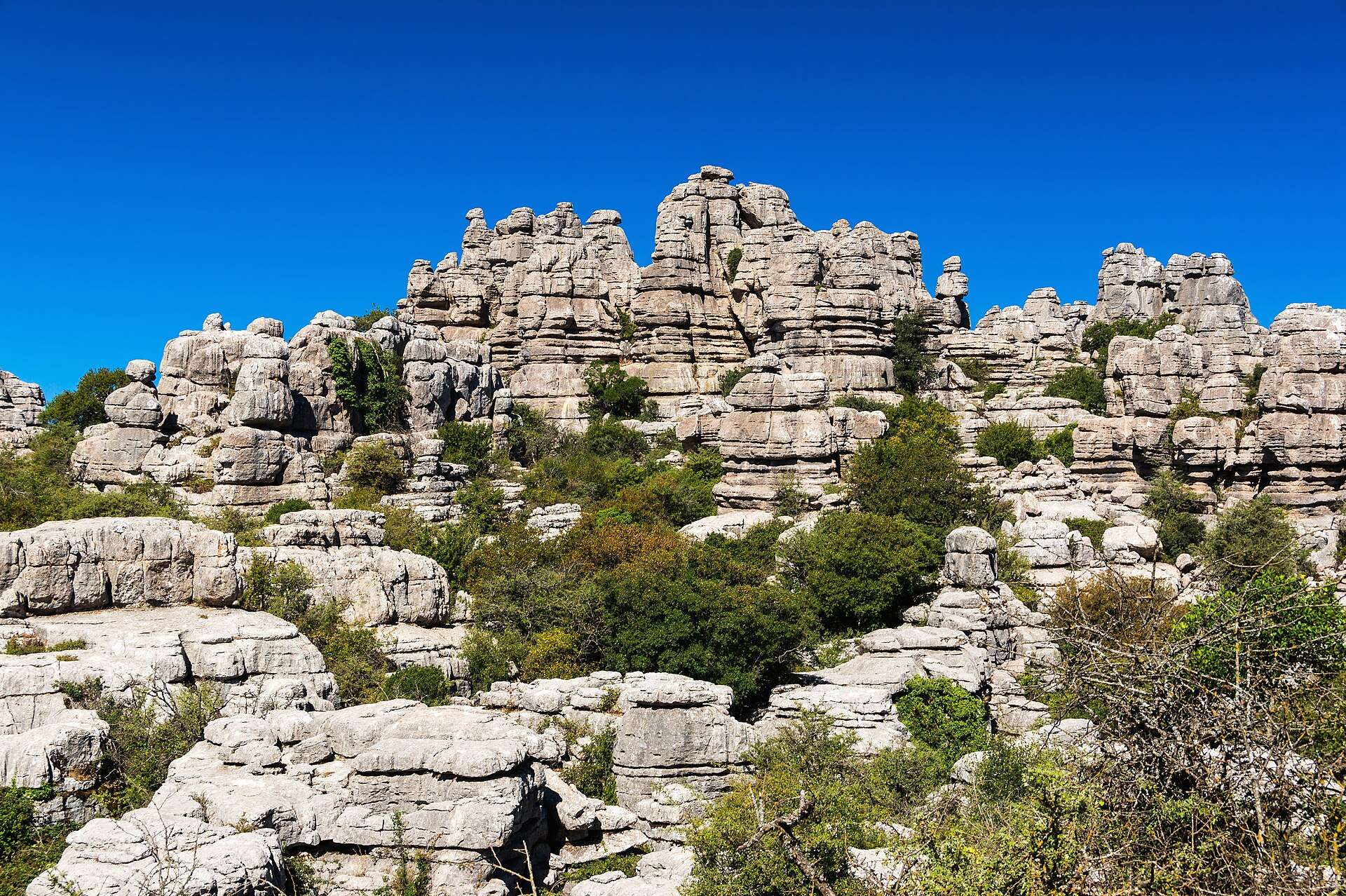
- El Torcal is the second act: the high karst plateau’s limestone strata, eroded into stacked-pancake towers and corridors — the old seabed per the alarm, lifted and carved — walked on the marked green and yellow loops from the visitor center (torcaldeantequera.com), with Iberian ibex posing on the ledges.
- The fog truth per the alarm: El Torcal makes its own weather — cloud sitting on the plateau closes the long views and turns the corridors gothic, which half its visitors consider the better version; the webcam-and-forecast check sorts the day’s order.
- The town between: the Alcazaba and collegiate church over the white sprawl, porra antequerana per the alarm (the town’s thicker, prouder gazpacho cousin) as the obligatory lunch, and mollete bread and bienmesabe rounding the register.

Getting there
The car unlocks the day’s designed shape — dolmens (edge of town), lunch (center), Torcal (20 minutes up the mountain road) — while the rail version covers town and stones and surrenders the karst to taxi arithmetic. El Torcal manages its small summit lot: full-lot moments close the road and a shuttle runs from the lower gate in busy seasons — the early afternoon arrival usually clears it. Both dolmen sites and the karst cost nothing per the alarm; the day’s only tickets are lunch.
The day
Menga opens it properly: the passage’s colossal uprights, the chamber’s dark held up by that 180-ton roof, and the doorway framing La Peña’s sleeping face on the horizon — the alignment per the alarm experienced exactly as designed five thousand years ago. Viera’s corridor and, a short drive on, El Romeral’s corbelled dome complete the ensemble at archaeologist pace. The town takes lunch: porra antequerana thick enough to argue with, the Alcazaba’s tower views for the walkers. El Torcal takes over the afternoon: the green loop’s hour or the yellow’s two through the stone-pancake corridors, ibex auditing from the ledges, and the mirador off the parking lot dropping the whole plain toward Málaga when the fog per the alarm permits. The descent lands you on the A-45 with the light going gold on the olive sea.
When to go
Spring and fall run the design weather: walkable karst, clear alignments, green plain. Summer bakes the plateau by midday — dolmens early, Torcal at evening, town siesta between is the honest inversion. Winter delivers the fog lottery per the alarm plus occasional snow on the karst, which photographs like Scotland wearing Andalusia’s light. The dolmens’ solstice and equinox mornings draw the archaeoastronomy faithful; La Peña needs no calendar to hold its profile.
Frequently Asked Questions
Why is the Menga alignment such a mystery?
Because European megaliths overwhelmingly orient to celestial events — solstice sunrises above all — and Menga instead aims at a landscape feature: the anthropomorphic mountain. It suggests the mountain itself was the sacred referent, a monumentalized landscape cult unique at this scale, and five thousand years left no explanatory note. The UNESCO listing cites exactly this singularity, and the doorway view per the alarm lets you stand in the question.
How were the stones moved?
The standard toolkit inferred for the age: quarries in the nearby hills, sledges and rollers on prepared beds, earthen ramps, and organized labor in the hundreds — with Menga’s 180-ton capstone ranking among the heaviest stones moved in prehistoric Europe. The visitor center models the mechanics; the chamber makes the achievement physical.
Is El Torcal walking difficult?
The marked loops run rocky but engineered — the green route’s ~1.5 km suits most walkers with real shoes; the yellow’s ~3 km adds scrambly moments and the better corridors. Off-trail wandering is prohibited and genuinely disorienting in fog per the alarm. The boardwalk mirador by the lot delivers the plain view at zero effort for the mobility-limited.
Will I actually see ibex?
Commonly — El Torcal’s Iberian ibex are habituated to the loops’ audiences and pose on the stacks at photogenic range, with early and late hours improving the odds. The rules are standard wildlife register: distance, no feeding, dogs leashed at minimum. Griffon vultures ride the plateau’s thermals as the supporting cast.
Antequera or Caminito del Rey from Málaga?
Both documented on this network: the Caminito for the booked-ticket gorge walkway adrenaline; Antequera for free prehistory and karst at choose-your-own pace. Timed thrill versus open-ended wonder — the honest Málaga week does both inland days, and Antequera is the one that never sells out.